CUSTOM WEB APPLICATION DEVELOPMENT
When a Website Isn't Enough
Every business has its own way of working. However, standard websites and off-the-shelf software don't always support those requirements.
ANTmore develops custom web applications and business tools around how your organization operates. As a result, your technology can support existing workflows and address specific needs rather than forcing your business to adapt to the software.
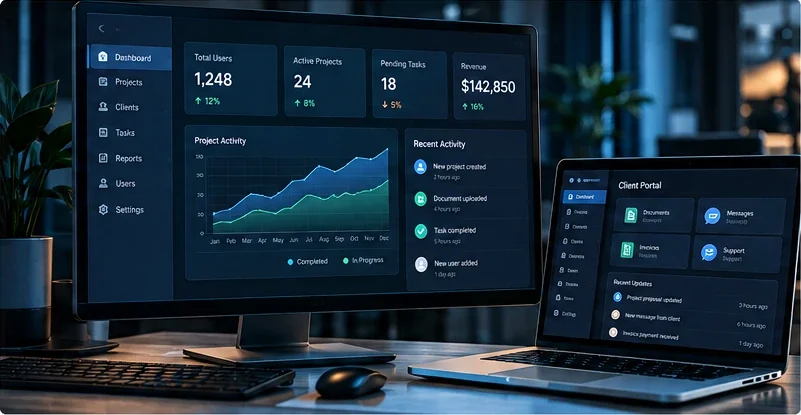
SOFTWARE SHOULD FIT THE WORK
The Workflow Shouldn't Have to Fit the Software
Off-the-shelf software is often designed around the needs of the average customer. Your organization may not operate like the average customer.
When existing platforms force employees into unnecessary steps, duplicate work, disconnected spreadsheets or manual processes, custom development can provide another option.
We begin by understanding what people are trying to accomplish before deciding what technology should be built.
Don't start with the application. Start with the problem.
Understand the workflow, the people, the information and the systems involved. Then determine what technology actually belongs between them.
CUSTOM SOLUTIONS
Web Applications Built Around Real Requirements
A custom web application can take many forms. What matters is whether it solves the operational problem it was built to address.
Internal Business Tools
Purpose-built tools that help employees manage information, processes and day-to-day operations.
Database Applications
Web-based interfaces for organizing, managing, searching and working with business data.

Customer & Client Portals
Secure web experiences that give customers, clients or partners access to the information and functionality intended for them.
Workflow Automation
Applications that reduce repetitive manual processes and move information through defined business workflows.
API & System Integrations
Connect websites, applications and external services so information can move between systems more effectively.
Reporting & Dashboards
Interfaces that bring important information together so teams can monitor activity and make better-informed decisions.
THE TECHNOLOGY BEHIND THE BUSINESS
Some of the Most Valuable Web Development Isn't Public
Customers may see your public website, but your organization depends on technology working behind it.
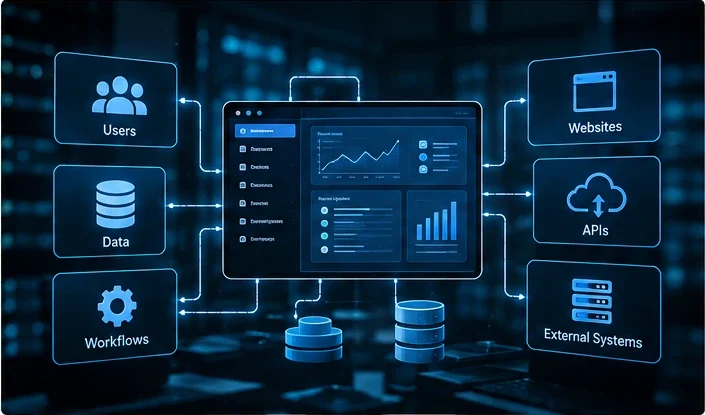
For example, employees may rely on internal tools, customer records, reporting systems, and administrative workflows to complete everyday tasks. These systems may need to communicate with one another, even when they serve different purposes.
Because these tools support important business activities, their reliability and usability matter just as much as their technical capabilities.
INTEGRATIONS
Your Application Doesn't Have to Live in Isolation
A custom application often becomes most useful when it can communicate with the other technology your organization already depends on.
APIs
Exchange information with platforms and services that provide an appropriate API.
Existing Websites
Connect custom functionality with an organization's public website or other web properties.
Databases
Store, retrieve and manage information around the requirements of the application.
External Systems
Integrate compatible third-party services when information or functionality needs to move between platforms.
Integration decisions should follow the business requirement.
Connecting two systems only makes sense when doing so improves the workflow they support.
FROM PROBLEM TO WORKING SOFTWARE
Understand Before We Build
01 — Discover
Understand the business problem, the people involved and what the current process looks like.
02 — Define
Identify requirements, workflows, data and the functionality the application actually needs.
03 — Plan
Determine how the application should be structured and how its different components will work together.
04 — Develop
Build the application and connect the functionality required by the project.
05 — Test
Test workflows, functionality and application behavior before deployment.
06 — Launch & Support
Deploy the application and continue improving it as requirements evolve.
PURPOSE-BUILT DEVELOPMENT
Custom Doesn't Mean Complicated for the Sake of Being Custom
The purpose of custom development isn't to build the most elaborate system possible. Instead, it's to create the technology necessary to solve the problem effectively.
Sometimes that means developing a focused internal tool. In other cases, the right solution may involve connecting several existing systems. As requirements evolve, a project may eventually grow into a larger application.
Ultimately, the architecture should reflect the business problem—not unnecessary technical complexity.
Build for the requirement you actually have.
Leave room for the application to evolve without building complexity simply because you might need it someday.
CHOOSING THE RIGHT APPROACH
Not Every Problem Needs the Same Kind of Development
Website Development
Best when the primary requirement is presenting information, marketing services, publishing content or creating a public-facing digital presence.
Custom WordPress Plugin
Best when the required functionality belongs inside an existing WordPress environment and should work with WordPress content, users or workflows.
Custom Web Application
Best when the requirement involves specialized workflows, data, users or functionality that goes beyond what a conventional website or CMS should be responsible for.
2007
ANTmore Technologies
Incorporated
DEVELOPMENT EXPERIENCE
Nearly Two Decades of Web Development Experience
Custom applications require more than programming skills. They also depend on an understanding of websites, databases, APIs, content systems, user interfaces, and the business processes connecting them.
Since 2007, ANTmore Technologies has worked across web development, WordPress, ecommerce, integrations, and custom functionality.
As a result, that broader experience helps us evaluate an application as part of an organization's overall technology environment rather than as an isolated piece of software.
HAVE SOMETHING DIFFERENT IN MIND?
Tell Us What You're Trying to Build
You don't need to know what technology the project requires before contacting us. Tell us about the problem, the workflow and what you're trying to accomplish. We'll start there.